Monday to Saturday 9:00am – 8:00pm

Spiral Heat Exchanger Manufacturer & Supplier in India

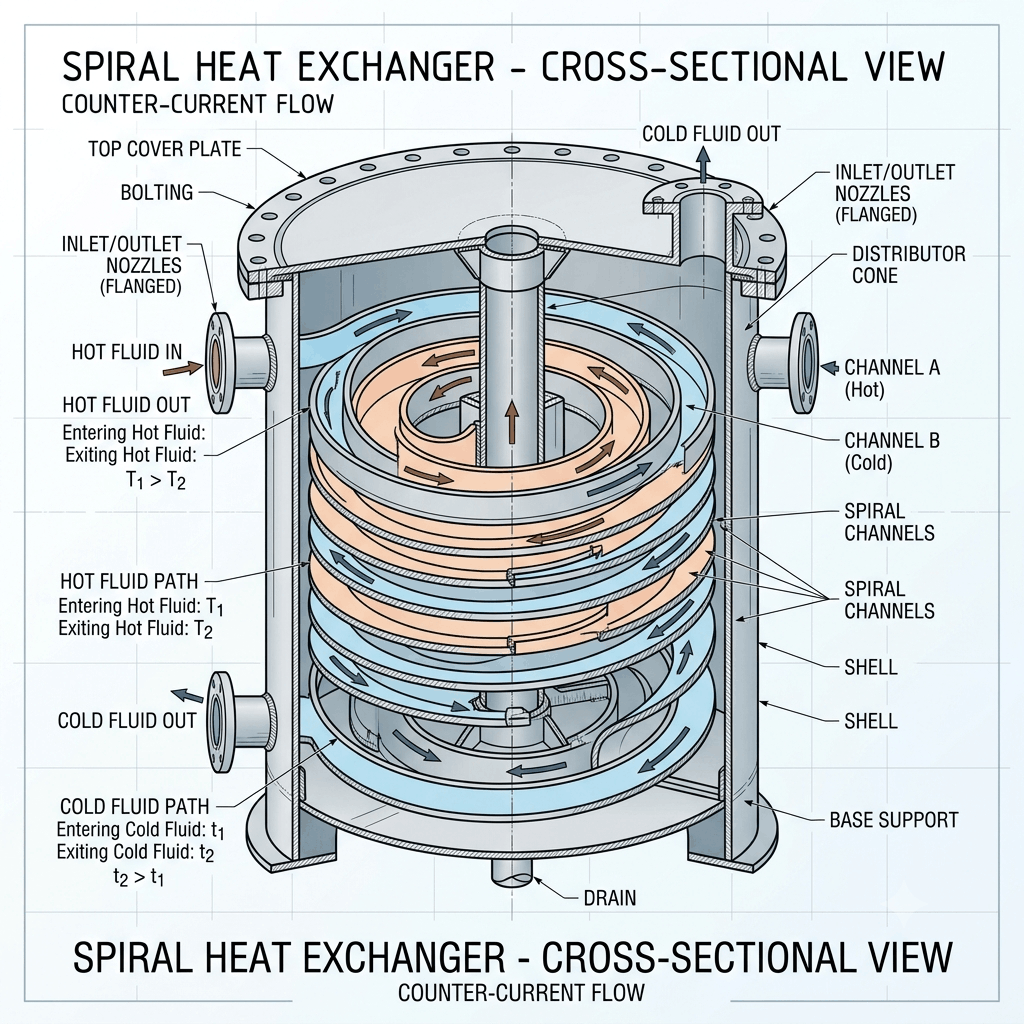
A spiral heat exchanger is a compact heat transfer device that uses two long metal sheets coiled into concentric spiral channels, allowing two fluids to flow in counter-current paths. Its single-channel design creates high turbulence and a self-cleaning effect, making it ideal for fouling fluids, slurries, and viscous media.

Thermocare Boilers Pvt Ltd (TBPL) designs and manufactures high-efficiency  engineered to your exact process conditions. With over 25 years of experience in industrial heating and cooling, we supply rugged, space-saving spiral units to pharmaceutical, chemical, food, textile, paper, and wastewater plants across India and overseas.
spiral heat exchanger supplier in India

What Is a Spiral Heat Exchanger?

A spiral heat exchanger (also called a spiral plate heat exchanger) is built from two coiled metal plates that form two continuous, curved channels wrapped around a central core. One fluid flows through the first channel while the second fluid flows counter-currently through the other, transferring heat across the plate wall.

Because each fluid travels through a single, uninterrupted passage, the design generates high velocity and high shear rates. This turbulence scours the channel walls, producing a self-cleaning action that resists clogging the key reason spiral units outperform conventional exchangers when handling difficult, particle-laden, or high-viscosity fluids.

Get a Quote

+91 88741 95414

Call Us For More Details

How It Works

The curved flow path forces continuous directional change, increasing turbulence even at low flow rates. This delivers heat transfer coefficients up to twice as high as a comparable shell and tube heat exchanger, while the compact spiral geometry occupies as little as 30% of the floor space of an equivalent tubular unit.

Key Components

  • Spiral coil – the coiled plates forming the two channels
  • Core – the central spool the plates are wound around
  • Shell / body – the outer cylindrical casing
  • Cover doors – hinged covers for full access to the heat transfer surface
  • Connections – inlet and outlet nozzles for both fluids
  • Sealing & C-clamps – ensure leak-tight, serviceable closure

Types of Spiral Heat Exchangers We Manufacture

Type I – Both-Side Openable

A single-channel design that produces high shear rates and a self-cleaning effect to prevent clogging. Channel width and spiral diameter are matched to your flow rate and fluid properties, making this type the preferred solution for high-viscosity media, sludges, and fouling liquids. Hinged covers on both sides open fully for fast inspection and cleaning, maximising uptime.

Type II – Fully Welded

A sturdy, compact, fully welded unit built for solvent condensing and process heating/cooling. Used widely in solvent recovery, it achieves condensing efficiency above 95% with cross-flow vapour entering from the top and condensate collected at the bottom. In vacuum duty it delivers a lower pressure drop on the solvent side, and in multipurpose distillation plants it provides a high-performance condenser in a fraction of the space.

Advantages of a Spiral Heat Exchanger Over Shell and Tube

Feature

Spiral Heat Exchanger

Shell & Tube Heat Exchanger

Footprint

Very compact (~30% of equivalent area)

Large, lengthy

Fouling resistance

Self-cleaning, single channel

Prone to fouling/clogging

Heat transfer coefficient

Up to 2× higher

Standard

Best for

Slurries, sludge, viscous & fibrous fluids

Clean, low-fouling fluids

Maintenance access

Hinged covers, easy cleaning

Tube bundle pull required

Pressure drop (vacuum duty)

Lower on solvent side

Higher

Core Benefits at a Glance

  • Self-cleaning single-channel flow that handles fibers, solids, and fouling media without blockage
  • Compact footprint that frees valuable plant space
  • High thermal performance with heat transfer coefficients up to twice that of tubular designs
  • Low maintenance with full hinged-cover access to the entire heat transfer surface
  • True counter-current flow for maximum temperature recovery

Custom material of construction for aggressive or corrosive duties

Get the Right Fit for Your Needs

Tell us your requirements and our team will get back to you with a tailored solution.

Applications

Designed to handle sludges, slurries, wastewater, wood pulp, hydrocarbons, and viscous, fouling liquids containing fibers and solids. Common applications include:

  • Pharmaceutical – solvent recovery, condensing, process cooling
  • Chemical & Agrochemical – reactive and corrosive fluid duties
  • Petrochemical – hydrocarbon heating and cooling
  • Food, Dairy & Beverage – hygienic heating and cooling
  • Pulp & Paper, Steel & Paint – fibrous and abrasive media
  • Wastewater & Effluent Treatment – sludge and slurry heat recovery

Distillation plants – compact overhead condensers and reboilers

Spiral Heat Exchanger Specifications & Materials

Applications: Liquid/Liquid and Vapour/Liquid duties Material of Construction (MOC): Carbon steel, austenitic stainless steel (SS304L / SS316L), duplex stainless steel, Hastelloy, AL6XN, and other compatible alloys Design Standard: Frames designed and fabricated to ASME Section VIII, Division 1 Heat Transfer Area: From 1 m² up to 500 m² Design Pressure: Standard ratings, with higher pressure available on request

Every heat exchanger from Thermocare Boilers is custom-engineered — channel size, plate thickness, spiral width, and material are all selected to suit your fluid, temperature program, and duty

How Much Does a Spiral Heat Exchanger Cost?

Price depends on heat transfer area, material of construction, design pressure, and whether the unit is openable or fully welded. Because each unit is built to specification, we provide a tailored quote after reviewing your process data sheet. Contact our engineering team for accurate pricing.

Why Choose Thermocare Boilers as Your Manufacturer

With 25+ years of proven expertise in industrial heating and cooling, Thermocare Boilers Pvt Ltd is a trusted name for process equipment in India. We offer:

  • In-house design & manufacturing to ASME standards
  • Custom-engineered solutions matched to your exact duty
  • Wide material range including stainless and exotic alloys
  • End-to-end support — design, fabrication, installation, and after-sales service
  • Comprehensive post-sale support through our Annual Maintenance Contracts

Engineered in Kanpur and supplied across India and to international markets, our spiral heat exchangers are built for reliability, efficiency, and long service life.

Frequently Asked Questions

What is a spiral heat exchanger used for?

It used for heating, cooling, and condensing fluids that are difficult to handle — including slurries, sludge, wastewater, wood pulp, hydrocarbons, and high-viscosity or fouling liquids. It is common in pharmaceutical, chemical, food, paper, and effluent treatment plants.

How does a spiral heat exchanger work?

Two coiled metal plates form two spiral channels. One fluid flows through one channel and the second fluid flows counter-currently through the other, transferring heat across the plate wall. The curved single-channel path creates high turbulence and a self-cleaning effect.

What is the difference between a spiral and a shell and tube heat exchanger?

It is far more compact, resists fouling through its self-cleaning single-channel flow, and can deliver heat transfer coefficients up to twice as high. Shell-and-tube units are better suited to clean, low-fouling fluids but require more space and maintenance.

Why is a spiral heat exchanger called self-cleaning?

The single-channel design forces all flow through one passage, raising velocity and shear rate. This scouring action removes deposits from the channel walls, preventing clogging even with particle-laden or fibrous fluids.

What is the maximum heat transfer area of a spiral heat exchanger?

Thermocare Boilers manufactures spiral heat exchangers from 1 m² up to 500 m² of heat transfer area, with each unit custom-sized to the application.

Are spiral heat exchangers good for solvent recovery?

Yes. Fully welded spiral heat exchangers are widely used as solvent condensers and achieve condensing efficiency above 95%, making them highly effective in solvent recovery and distillation duties.

What design standard are your spiral heat exchangers built to?

Our heat exchanger frames are designed and fabricated to ASME Section VIII, Division 1 construction standards, with higher pressure ratings available on request.

Can a spiral heat exchanger handle high-viscosity fluids?

Yes. The single-channel design and adjustable channel width make spiral heat exchangers especially suitable for high-viscosity media, slurries, and fouling liquids that would block conventional exchangers

How do I clean and maintain a spiral heat exchanger?

Openable (Type I) units have hinged cover doors that provide full access to the entire heat transfer surface for fast mechanical or chemical cleaning. The self-cleaning flow also reduces how often cleaning is needed.

Do you supply heat exchangers outside India?

Yes. Thermocare Boilers manufactures in Kanpur, India and supplies spiral heat exchangers to both domestic and international markets.

How long does delivery of a custom spiral heat exchanger take?

Lead time depends on size, material, and design complexity. Share your process data sheet and our team will confirm an accurate delivery schedule with your quote.

Request a Quote from the Experts

Backed by 25+ years of experience, our team will provide a tailored quote to match your exact requirements.

C.M.D :

Mr. L.B Dixit
Contact : (+91) 9839081226
Email : thermocare12@rediffmail.com

Director :

Mr. Shivam Dixit
Contact : (+91) 8874195414
Email : shivamdixit014@gmail.com

Director :

Mrs. Suman Dixit
Contact : (+91) 9455658212
Email : thermocare12@rediffmail.com