

A natural draft cooling tower moves air using the chimney (stack) effect rather than a fan. Warm, less-dense air inside the tall tower rises and draws cooler ambient air in from the base, cooling the water as it falls through the fill. These are the large, hyperbolic towers seen at big power plants.
This guide explains how natural draft cooling towers work, their types, advantages and limitations, and how they compare with mechanical draft towers — plus what to consider when evaluating manufacturers.
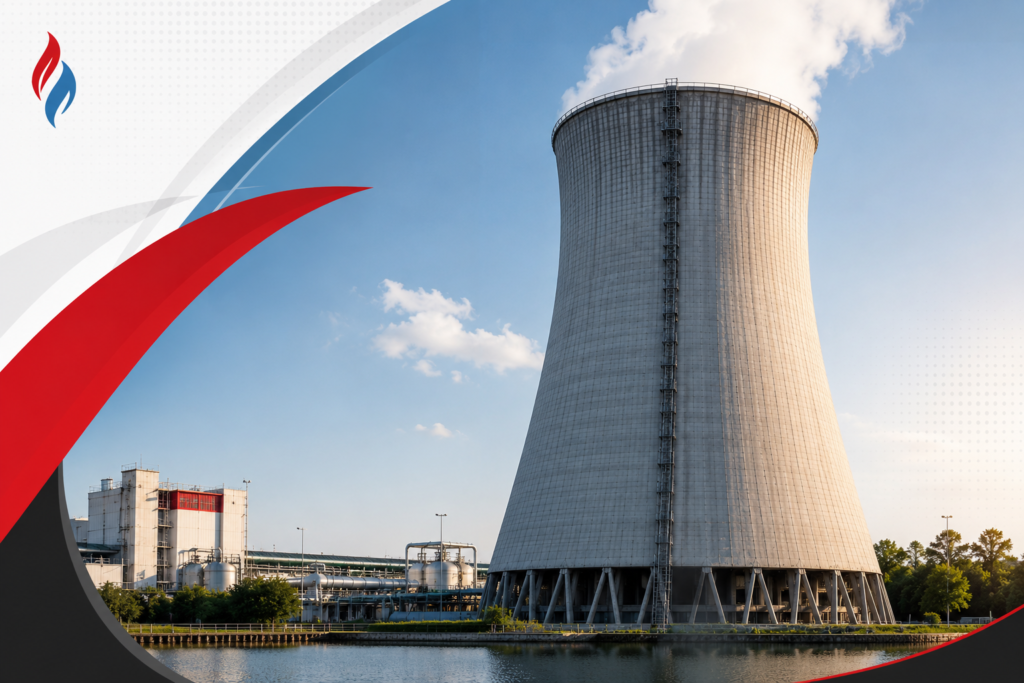
A natural draft (natural draught) cooling tower relies on the natural buoyancy of warm air to create airflow, instead of using mechanical fans. Hot water is distributed over the fill inside a very tall shell; as the air inside warms and becomes less dense, it rises and escapes the top, pulling fresh cool air in through openings at the base. This continuous chimney effect cools the falling water by evaporation.
Because the airflow is driven by the tower's height and the temperature difference, natural draft towers are built very large — often with the familiar hyperbolic shape — and are typically used for the huge heat loads of thermal and nuclear power plants.
The density difference between the warm, humid air inside the tower and the cooler, denser air outside creates an upward draft. The taller the tower and the greater the temperature difference, the stronger the airflow — all without any fan power.
|
Feature |
Natural Draft |
Mechanical Draft |
|---|---|---|
|
Airflow source |
Chimney effect (no fan) |
Fan-driven |
|
Fan power |
None |
Required |
|
Size |
Very large/tall |
Compact to large |
|
Best capacity |
Very high (power plants) |
Small to large |
|
Operating cost |
Low (no fan energy) |
Fan energy cost |
|
Footprint |
Large structure |
Smaller, modular |
Structured to win a comparison featured snippet for 'natural draft vs mechanical draft cooling tower.'
Natural draft towers suit only the largest heat loads, such as power generation. For most industrial and commercial duties, mechanical draft (induced or forced draft) cooling towers are more compact, cost-effective, and practical. As an experienced cooling tower manufacturer, Thermocare Boilers helps you choose the right type and supplies induced draft, counter flow, and cross flow towers sized to your duty. Explore our cooling tower manufacturer page to learn more.