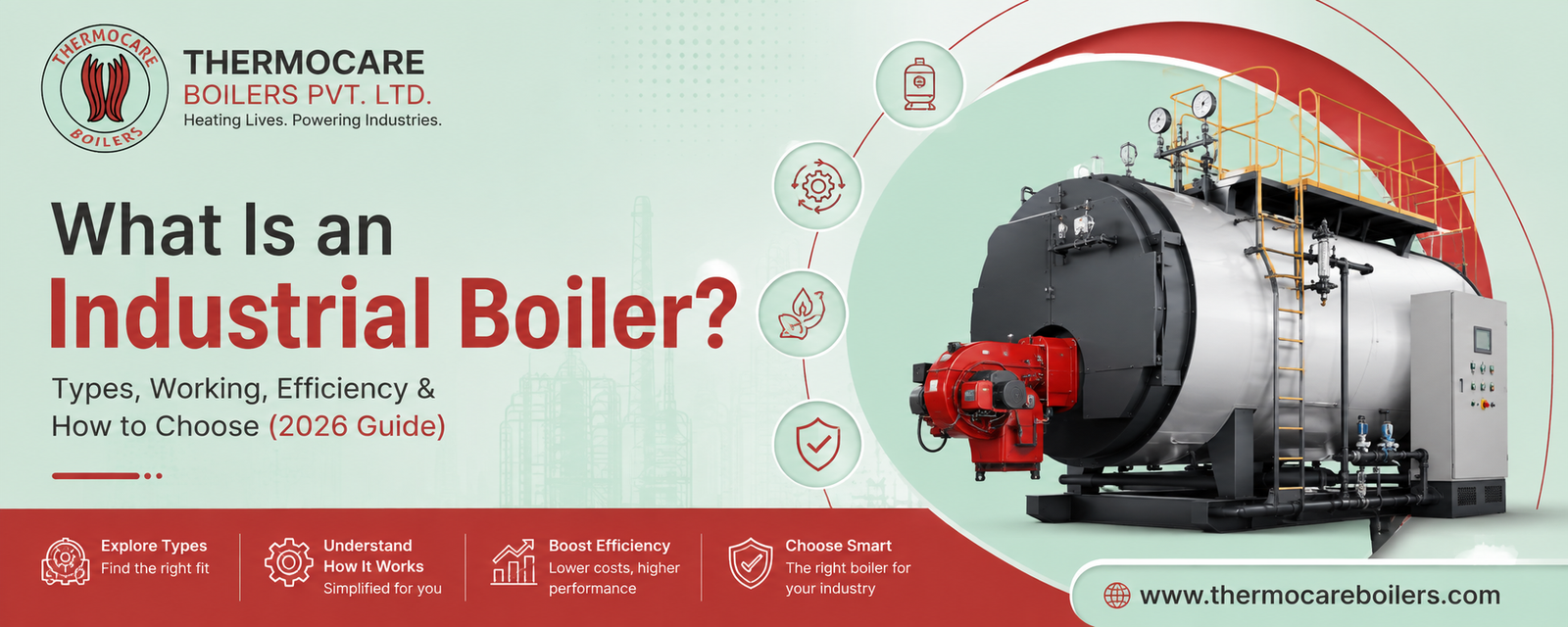
An industrial boiler is a closed pressure vessel that burns fuel — coal, biomass, oil, gas, or electricity — to convert water into steam or hot water, which a factory then uses for heating, drying, cooking, sterilizing, or generating power. Unlike a domestic boiler that only warms a home, an industrial boiler is engineered for high pressure, continuous 24/7 duty, and large steam output measured in kilograms or tonnes per hour (kg/hr or TPH).
In almost every process plant, the boiler is the single most important utility. If it stops, the entire production line stops. If it runs inefficiently, it quietly burns money every hour of every shift — because fuel is usually the largest running cost in a boiler house, far bigger than the price of the boiler itself. That is why choosing, operating, and maintaining the right industrial boiler is a business decision as much as an engineering one.
This guide explains, in depth, what an industrial boiler is, how it works step by step, the full range of types, real-world efficiency and running cost in India, IBR compliance, feed-water treatment, common problems and fixes, and exactly how to select the right unit for your plant. It is written by the engineering team at Thermocare Boilers Pvt Ltd, a Kanpur-based industrial boiler manufacturer and supplier that has designed, built, installed, and serviced steam systems for 300+ plants — including Hindustan Coca-Cola, PepsiCo, Reliance Industries, and Bisleri — for over 25 years.
An industrial boiler is a fuel-fired or electrically heated pressure vessel that transfers combustion heat into water to generate steam or hot water for industrial use. The heat energy locked inside the fuel is released through combustion, transferred to water across metal heating surfaces, and carried away as steam or hot water through a network of pipes to the machines and processes that need it.
The reason steam is so widely used across industry is simple physics: water can absorb an enormous amount of heat energy when it turns into steam, and it gives that energy back cleanly and controllably wherever it condenses. One kilogram of steam carries far more usable heat than one kilogram of hot water at the same temperature, which makes steam an extremely efficient way to move heat around a factory.
Three characteristics separate a true industrial boiler from a home heating unit:
Because they operate under pressure and at high temperature, industrial boilers are potentially hazardous if poorly built or badly maintained — which is exactly why they are regulated by law in India under the Indian Boiler Regulations, covered later in this guide.
Understanding the parts of a boiler makes maintenance, troubleshooting, and buying decisions far easier. Below are the main components and the specific job each performs.
| Component | Function |
|---|---|
| Burner / grate | Burns liquid or gaseous fuel (burner) or holds and burns a bed of solid fuel (grate). Combustion quality here decides both efficiency and emissions. |
| Furnace / combustion chamber | The enclosed space where fuel actually burns. Most heat transfer here is radiant, from the flame directly to the surrounding surfaces. |
| Fire tubes or water tubes | The heating surfaces that transfer heat between hot gas and water. Their design defines the boiler type. |
| Boiler drum / shell | The main vessel that holds water and provides space for steam to separate from the water surface. |
| Economizer | A heat exchanger that uses leftover flue-gas heat to preheat incoming feed water — one of the cheapest ways to raise efficiency. |
| Superheater | Removes the last moisture from steam and raises its temperature to produce “dry” superheated steam, needed for turbines and certain processes. |
| Safety valve | The single most important safety device — it automatically releases steam if pressure rises beyond a safe limit, preventing an explosion. |
| Feed-water pump | Forces treated water into the boiler against the internal pressure, keeping the water level correct. |
| Chimney / flue stack | Safely carries spent combustion gases out and away, and provides draught for combustion. |
| Water-level controls & low-water cutoff | Continuously watch the water level and cut off firing if it drops dangerously low — a critical protection against overheating. |
| Controls & instrumentation | Gauges, sensors, and automation that regulate pressure, level, temperature and trip the boiler safely on any fault. |
Every one of these parts contributes to three goals: safe operation, efficient heat transfer, and clean combustion. A weakness in any single component — a leaking safety valve, a scaled tube, a failing feed pump — pulls down the performance of the entire system. Well-chosen steam line accessories such as traps, PRVs, and moisture separators keep the whole system safe and loss-free.
The working principle of every industrial boiler comes down to two things happening together: controlled combustion to release heat, and efficient heat transfer of that heat into water. Here is the complete cycle, stage by stage.
Step 1 — Feed water enters the boiler. Treated water is pumped into the boiler by the feed pump. This water must be softened or RO-treated to control its total dissolved solids (TDS) and pH. Untreated hard water deposits scale on the heating surfaces, and scale acts like an insulating blanket that blocks heat from reaching the water — silently wasting fuel and eventually cracking tubes.
Step 2 — Fuel and air mix and ignite. In the burner (for oil or gas) or on the grate (for solid fuel), the fuel is mixed with the right amount of combustion air and ignited. The air-to-fuel ratio is critical: too little air leaves unburnt fuel and soot; too much air carries usable heat straight up the chimney. Good combustion control is where a large share of a boiler’s efficiency is won or lost.
Step 3 — Combustion heat transfers to the water. The hot combustion gases now give up their heat to the water across the heating surfaces. Exactly how depends on the boiler type:
Inside the furnace, heat transfer is mostly radiant (from the flame); further along, as gases cool, it becomes mostly convective (from the moving gas).
Step 4 — Steam or hot water is produced. Once the water reaches boiling point at the operating pressure, it turns into pressurized steam (or, for lower-temperature duties, simply hot water). The higher the pressure, the higher the temperature at which water boils and the more energy the steam carries.
Step 5 — Steam is dried and conditioned. Steam leaving the water surface carries some moisture. A superheater (where fitted) removes that moisture and raises the temperature further, producing dry superheated steam that flows smoothly to turbines or process equipment without damaging condensate.
Step 6 — Pressure and temperature are automatically controlled. The boiler’s control system continuously modulates the flame to hold the target pressure. If demand drops and pressure climbs too high, the safety valve lifts and vents steam to protect the vessel. Modern boilers use modulating burners that smoothly ramp up and down rather than crude on/off cycling, which saves fuel and reduces stress on the metal.
Step 7 — Flue gas gives up its last heat, then exits. Before leaving, the hot flue gas passes through the economizer, where it preheats the incoming feed water and reclaims energy that would otherwise be lost. The cooled gas then exits safely through the chimney.
Step 8 — Condensate is recovered and returned. In an efficient plant, the steam that has given up its heat and condensed back into hot water is collected and pumped back to the feed tank. This condensate is already hot and already treated, so recovering it saves both fuel and expensive treated water. Plants that ignore condensate recovery throw away one of the easiest savings available.
The two biggest levers on fuel cost: water treatment and heat recovery. Even 1 mm of scale on a heating surface can raise fuel consumption by roughly 5–8%. Economizers and condensate recovery are consistently the cheapest fuel savings available in any boiler house — often paying for themselves within a year.
Industrial boilers are classified in two ways: by construction (how the gas and water are arranged) and by fuel (what they burn). Understanding both is essential to choosing correctly.
In a fire-tube boiler, the hot combustion gases travel through tubes that are completely surrounded by water inside the shell. The heat passes from the gas, through the tube walls, into the water.
These are simpler in design, lower in cost, quick to start, and easy to maintain — but they are limited to low and medium pressure because the large water-filled shell cannot safely hold very high pressure. Fire-tube designs are described by the number of “passes,” meaning how many times the gas reverses direction inside the boiler:
Best suited to: food and beverage plants, namkeen and snack units, dairies, textiles, hospitals, laundries, and small-to-medium factories that need reliable, moderate-pressure steam boiler capacity without a large capital outlay.
Here the arrangement is reversed: water circulates inside the tubes while the hot combustion gases pass around them. Because the water is contained in relatively small, strong tubes rather than a large shell, water-tube boilers can safely handle very high pressure and produce very large volumes of steam.
Heat transfer happens in stages: radiant heat in the furnace, convective heat across the tube bundle, then optional superheating (to dry the steam) and an economizer (to preheat feed water).
Best suited to: power generation, refineries, large chemical and paper plants, sugar mills, and co-generation setups — any application needing high pressure or large-scale steam.
| Type | Fuel used | Best for | Main trade-off |
|---|---|---|---|
| Solid-fuel / biomass boiler | Coal, wood, briquettes, rice husk, mustard husk, bagasse, agro-waste | Indian plants with cheap local agro-waste; namkeen units, rice mills, plywood, textiles | Needs ash handling and emission control |
| Oil-fired boiler | Diesel, furnace oil (FO), light diesel oil (LDO) | Steady, high-temperature steam; food, textiles, manufacturing | Higher fuel cost; CO₂ emissions need flue treatment |
| Gas-fired boiler | Natural gas, LPG, PNG | Clean, fast-responding, highly automated plants; pharma, chemicals | Requires a gas pipeline or reliable supply |
| Electric boiler | Electricity | Labs, small units, zero on-site emissions, carbon-neutral goals | High running cost where power tariffs are high |
| Multi-fuel boiler | Wood + coal + briquettes, or dual oil/gas burners | Plants wanting protection from fuel-price swings | Slightly higher capital cost |
| Waste-heat recovery boiler (WHRB) | Exhaust heat from engines, furnaces, DG sets | Refineries, cement, glass, co-generation — effectively “free” steam | Depends on having usable waste heat available |
| Thermic fluid heater | Coal, wood, oil, or gas (heats oil, not water) | High process temperature (~300°C) at low pressure; plastics, textiles, food | Not a steam boiler — a different technology for a different duty |
Thermocare manufactures IBR & Non-IBR steam boilers, thermic fluid heaters, hot water and hot air generators, and heat exchangers, so the fuel and construction can be matched precisely to your actual load — rather than forcing your process onto a fixed catalogue model.
The choice between fire-tube and water-tube construction is one of the most important decisions in specifying a boiler. This table lays out the practical differences.
| Feature | Fire-Tube Boiler | Water-Tube Boiler |
|---|---|---|
| Gas / water arrangement | Hot gas inside tubes, water around | Water inside tubes, hot gas around |
| Pressure range | Low to medium | Medium to very high |
| Efficiency | Good | High |
| Startup time | Fast | Slower |
| Capital cost | Lower | Higher |
| Steam capacity | Small to medium | Medium to very large |
| Water volume held | Large | Small |
| Safety on failure | More stored energy to release | Lower stored energy — safer at high pressure |
| Maintenance | Simpler, easier access | More complex |
| Typical applications | Food, textiles, snack plants, hospitals | Power plants, refineries, heavy process industry |
Simple rule of thumb: if you need moderate pressure and quick, dependable steam for a factory line, a fire-tube boiler usually wins on cost, simplicity, and ease of maintenance. If you need very high pressure or large-scale power generation, a water-tube boiler is the right — and often the only — choice.
Boiler efficiency is the percentage of the fuel’s energy that actually ends up in your steam, rather than escaping up the chimney or lost as radiation. It directly determines your fuel bill. Modern industrial boilers deliver anywhere from 70% to 95% efficiency, and the exact figure depends heavily on fuel type and heat-recovery accessories.
| Fuel and setup | Typical real-world efficiency |
|---|---|
| Oil / gas with economizer | ~85–92% |
| Oil / gas, basic (no economizer) | ~80–86% |
| Solid fuel / biomass | ~70–80% |
| Any fuel with waste-heat recovery + condensate return | Highest overall plant efficiency |
A professional steam audit or trap survey typically uncovers 5–15% fuel savings in an average plant — and because fuel is the dominant running cost, that saving usually repays the cost of the audit within a few months.
If there is one thing that quietly destroys boiler efficiency and lifespan, it is poor feed-water quality. This deserves its own section because so many plants underestimate it.
Raw water contains dissolved minerals (mainly calcium and magnesium) that precipitate out as hard scale when the water is heated. Scale forms an insulating layer on the heating surfaces, forcing the boiler to burn more fuel to push the same heat through, and eventually causing localized overheating that can rupture a tube. High dissolved solids also cause “carryover,” where water is carried into the steam and damages downstream equipment.
Effective feed-water management usually includes:
Because feed-water quality is so tightly linked to boiler efficiency and life, Thermocare also supplies industrial RO and water-softening plants matched to the boiler — so the whole system is protected, not just the vessel.
In India, industrial boilers are governed by the Indian Boiler Regulations (IBR), 1950 — a legal framework that exists because boilers operate under pressure and can be dangerous if poorly built or run.
IBR boiler. Generally, any boiler above 25 litres capacity operating above 1 kg/cm² pressure falls under IBR. An IBR boiler must be:
Non-IBR boiler. Units below those capacity and pressure thresholds fall outside IBR, avoiding the heavier compliance burden. This makes Non-IBR boilers popular for smaller steam loads where the process genuinely doesn’t need a large, high-pressure unit.
The compliance paperwork intimidates many buyers, but it shouldn’t — a competent manufacturer prepares the complete IBR documentation and coordinates the directorate inspection on your behalf, so you receive a fully certified, legally compliant boiler without navigating the bureaucracy yourself. Thermocare handles IBR documentation, inspection, and commissioning as a standard part of supply.
Industrial boiler price varies widely, because a “boiler” can mean anything from a small packaged unit to a multi-tonne high-pressure system. Small Non-IBR units start in the range of a few lakh rupees, while large multi-TPH IBR boilers run considerably higher.
The main factors that drive the price are:
The most useful figure is not the sticker price — it is the total cost of ownership over the boiler’s 15–30 year life, which is dominated by fuel. A boiler that costs more upfront but runs a few percentage points more efficiently frequently repays that premium within a couple of years and then keeps saving for decades. When comparing quotes, always compare guaranteed efficiency and fuel cost per tonne of steam, not just the purchase price.
To get an accurate figure, share your required capacity, pressure, and fuel preference with a supplier. Thermocare responds to enquiries within 24 hours with a recommendation and budget estimate.
Selecting a boiler is a decision you live with for 20+ years, so it pays to do it methodically. Work through these steps in order.
The versatility of steam means industrial boilers serve an enormous range of sectors. Here is where they typically fit.
| Industry | What the boiler does |
|---|---|
| Food & beverage | Cooking, sterilization, pasteurization, cleaning-in-place |
| Namkeen & snacks | Frying-line heating via steam or thermic fluid |
| Power generation | Steam drives turbines to generate electricity |
| Chemicals & petrochemicals | Reaction heating, distillation, process steam |
| Textiles | Dyeing, bleaching, sizing, fabric finishing |
| Pharmaceuticals | Clean/pure steam for sterilization and controlled processes |
| Paper & pulp | Drying paper and regulating process temperature |
| Rice & sugar mills | Husk- and bagasse-fired steam plus co-generation |
| Plywood, leather, rubber | Pressing, curing, and process heat |
| Packaging & printing | Process heating and drying |
| Hospitals & laundries | Sterilization, hot water, and steam cleaning |
| Dairy | Pasteurization, sterilization, and hot-water duties |
Knowing the typical failure modes helps you catch small issues before they become expensive breakdowns.
Most of these are cheap to prevent and expensive to ignore — which is the entire logic behind a structured maintenance programme.
Regular, disciplined maintenance is what separates a boiler that runs efficiently for 25 years from one that limps along burning excess fuel and risking accidents.
Routine maintenance schedule:
Safety non-negotiables:
An Annual Maintenance Contract (AMC) keeps a boiler compliant, efficient, and running by covering scheduled servicing, spares guidance, emergency response, and IBR renewal support on a fixed schedule — removing the risk of “we forgot to service it” until something fails.
The industrial boiler is evolving under three pressures: sustainability, digitalisation, and rising energy costs.
What is an industrial boiler in simple words? It is a large, sealed vessel that burns fuel to boil water into steam (or hot water), which factories then use for heating, drying, cooking, sterilizing, or generating power.
What are the main types of industrial boilers? By construction, there are fire-tube and water-tube boilers. By fuel, there are solid-fuel/biomass, oil-fired, gas-fired, electric, and multi-fuel boilers, plus waste-heat recovery boilers and thermic fluid heaters.
What is the difference between a fire-tube and a water-tube boiler? In a fire-tube boiler, hot gas passes through tubes surrounded by water, which suits low-to-medium pressure and is cheaper and quicker to start. In a water-tube boiler, water flows through tubes with hot gas outside, which suits high pressure and large capacity.
How efficient are modern industrial boilers? Typically 70–95%, depending on fuel and heat recovery. Oil/gas units with an economizer reach the high 80s to low 90s; solid-fuel units generally run around 70–80%.
What is an IBR boiler? A boiler regulated under the Indian Boiler Regulations, 1950 — generally above 25 litres capacity and 1 kg/cm² pressure — requiring registration, inspection, certified documentation, and a certified operator.
How much does an industrial boiler cost in India? It depends on capacity, pressure, fuel, and IBR/Non-IBR class. Small Non-IBR units start at a few lakh rupees, while large multi-TPH IBR boilers cost significantly more. The dominant lifetime cost is fuel, not the purchase price.
Which fuel is cheapest for a boiler in India? Usually agro-waste such as rice or mustard husk and wood chips in North India, followed by coal, then oil and gas. Electric costs more to run but needs no fuel handling or emissions clearance.
How long does an industrial boiler last? With proper maintenance and IBR-compliant operation, an industrial boiler typically lasts 15 to 30 years.
Why does feed-water quality matter so much? Hard or untreated water forms scale on the heating surfaces, which insulates them, wastes fuel, and can eventually fail tubes. Softening or RO treatment protects both efficiency and boiler life.
When should I use a thermic fluid heater instead of a steam boiler? When your process needs high temperature (up to around 300°C) but at near-atmospheric pressure — avoiding the pressure, water treatment, and statutory compliance that steam involves.
How can I reduce my boiler’s fuel bill? Fix steam-trap failures, recover condensate, insulate lines, add an economizer or waste-heat recovery, control excess air at the burner, and treat the feed water. A steam audit commonly finds 5–15% savings.
What safety features should an industrial boiler have? Safety valves, low-water cutoff, level controllers, pressure switches, flame-failure protection, and interlocked burner controls — compliant with IBR requirements where applicable.
The right supplier does far more than sell you a vessel. They size the boiler to your real load, build it to specification, handle the IBR documentation, install and commission it on site, train your operators, and support it for its entire working life. That accountability — one team responsible from enquiry to decades of service — is what protects your production and your fuel bill over the long run.
Thermocare Boilers Pvt Ltd is a Kanpur-based industrial boiler manufacturer and supplier serving plants across India since 2000. We design, manufacture, install, and maintain IBR & Non-IBR steam boilers, thermic fluid heaters, hot water and hot air generators, heat exchangers, RO and water-softening plants, cooling systems, and pollution-control equipment — all engineered, installed, and maintained by one accountable team. From a 100 kg/hr unit for a small snack plant to multi-TPH IBR boilers for large process facilities, we size and customise each system to your actual load rather than a catalogue average. Our clients include Hindustan Coca-Cola Beverages, PepsiCo, Reliance Industries, Bisleri, MKU Limited, and 300+ others nationwide.
Ready to size the right boiler for your plant? Tell us your required capacity, pressure, fuel, and industry, and our engineers will respond within 24 hours with a recommendation and budget estimate.
📞 +91 98390 81226 | ✉️ sales@thermocareboiler.com 🔗 Request a Quotation